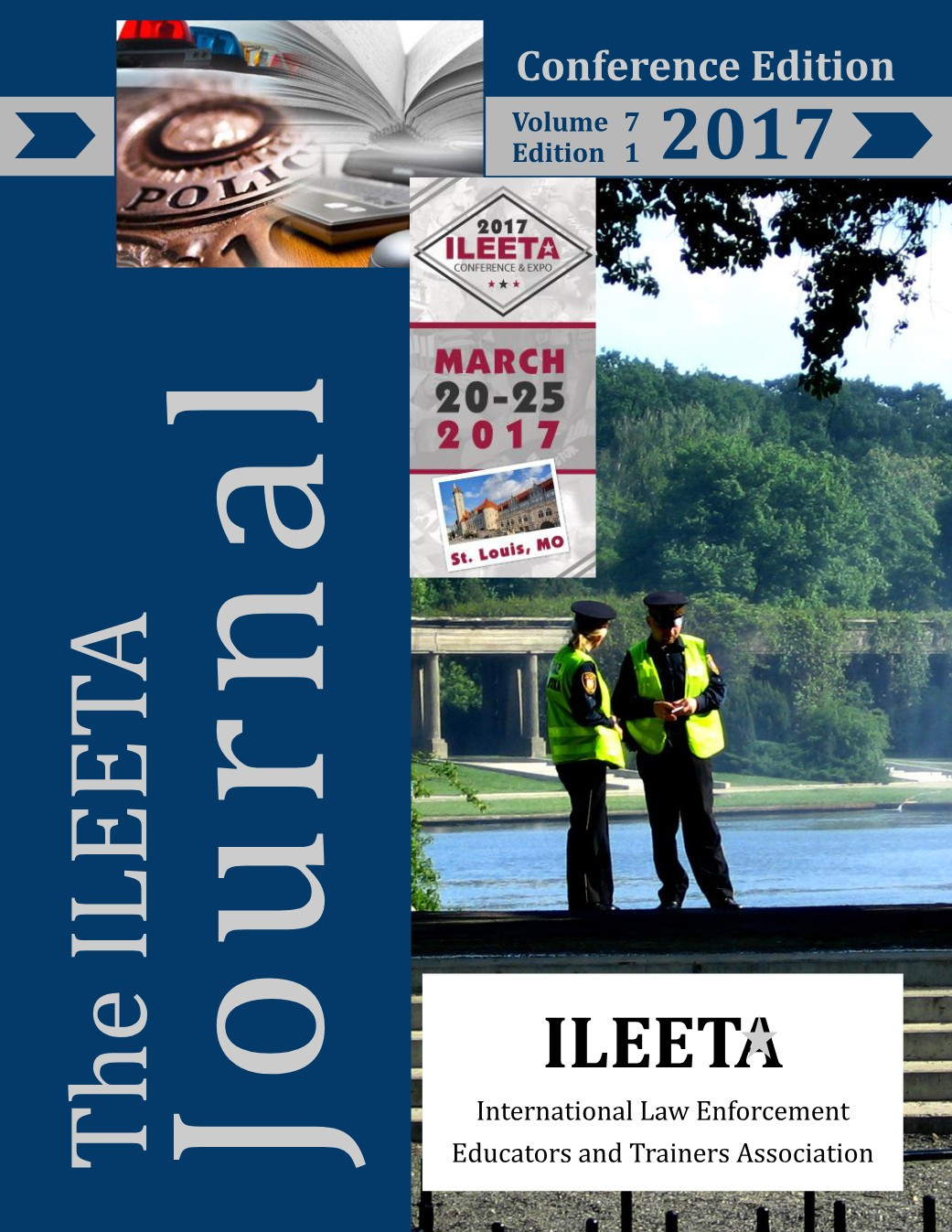
 Volume 7, Edition 1
Conference Edition 2017
Read the complete issue
ILEETA Journal Archive
The 2017 ILEETA Journal follows the training year from conference preparation through winter reflection. Across four editions, contributors examine force decision-making, field training, scenario design, report writing, mental health, resilience, instructor growth, and the responsibility to keep learning after expertise has been earned.
Volume 7, Edition 1 Volume 7, Edition 2
 Volume 7, Edition 3
 Volume 7, Edition 4
The conference edition combines practical course previews with advice for making the most of the ILEETA experience. Its range reflects the association itself: officer safety, force, instructor development, wellness, leadership, resilience, and the conversations that continue outside the classroom.
Taylor argues that force-report writing should not be separated from force training. Officers may write reports throughout their careers, yet ordinary incident-report habits do not necessarily prepare them to explain perception, decision-making, threat assessment, and the totality of circumstances surrounding force. The article encourages instructors to make articulation part of scenarios and practical exercises rather than an afterthought. Doing so allows officers to connect actions with observable facts, identify gaps in their understanding, and practice communicating why a response made sense from their position at the time.
Topics: Use-of-force reports; articulation; scenario training; decision-making
Citation: Paul Taylor. (2017). Integrating the Use-of-Force Report into Your Use-of-Force Training. The ILEETA Journal, 7(1), 26-28.
Der places the learner at the center of the training environment. Instructors can present information, create exercises, and provide feedback, but students must actively construct understanding and take responsibility for applying it. The article encourages trainers to use participants as resources for one another, invite meaningful choices, and design activities that make thinking visible. Empowerment does not mean abandoning standards or structure; it means creating conditions in which learners engage, contribute, reflect, and recognize their own role in improvement. The result is training done with students, not merely delivered to them.
Topics: Learner engagement; student responsibility; facilitation; adult learning
Citation: Jason Der. (2017). Empowering Students to Learn. The ILEETA Journal, 7(1), 35-36.
The spring edition explores simulators, interpreters, active-shooter terminology, coaching, crime data, line-of-duty loss, leadership, family impact, and the growing role of video evidence.
Blake presents force-options simulators as more than firearms devices. Used thoughtfully, they can support judgment, communication, force selection, research, community engagement, and structured discussion of officer performance. The article emphasizes that technology alone does not create learning; instructors must define objectives, select or build appropriate scenarios, observe decisions, and conduct productive debriefs. Simulator work can also reveal how context changes interpretation and allow repeated examination of complex encounters. The value lies in combining controlled experience with reflection, not in treating the machine as a substitute for skilled instruction.
Topics: Force simulators; judgment; debriefing; training technology
Citation: Dave Blake. (2017). Force Options Simulators: An Underutilized Training Tool. The ILEETA Journal, 7(2), 5-7.
The fall issue connects tactical skills with instructor positioning, integrated force programs, rapport, professional standards, certification, drones, wellness, and the changing environment in which trainers work.
Blake challenges agencies that divide firearms, defensive tactics, electronic control devices, and other force instruction into isolated programs. A unified force-options unit can coordinate leadership, instructor selection, curriculum, terminology, and recurring practice across disciplines. The model also pushes agencies beyond choosing instructors solely for exceptional technical skill; teaching ability, legal understanding, judgment, and collaboration matter. By distributing integrated practice throughout the year, agencies can address learning decay and help officers transition among communication, control, less-lethal tools, and deadly force as conditions change.
Topics: Integrated force training; instructor selection; learning decay; program leadership
Citation: Dave Blake. (2017). The Force Options Unit: A Holistic Approach to Use of Force Training. The ILEETA Journal, 7(3), 15-16.
The winter edition remembers Jim Smith and includes candid reflections on joining ILEETA, de-escalation, traffic stops, defensive tactics, instructional perspective, reading, course-development workload, and officer wellness.
Avery makes visible the work hidden behind a polished class. Research, analysis, writing outcomes, building activities, developing media, reviewing content, testing delivery, revising materials, and documenting the course all require time. The article compares common development estimates and explains why converting existing classroom instruction to online or blended formats is not a simple transfer. For supervisors and subject-matter experts, it offers a realistic basis for planning. For instructors, it validates the disciplined labor that occurs before anyone enters the room and reminds us that efficient design is not hurried design.
Topics: Training development; instructional design; workload; resource planning
Citation: Kerry Avery. (2017). How Long Does It Take to Design Training?. The ILEETA Journal, 7(4), 25-26.