Ideas, experience, and the craft of training
The ILEETA Journal Archive
Travel through two decades of writing by and for law-enforcement educators and trainers. Choose a year or simply scroll to follow the profession’s continuing conversation about teaching, judgment, safety, leadership, wellness, and better performance.
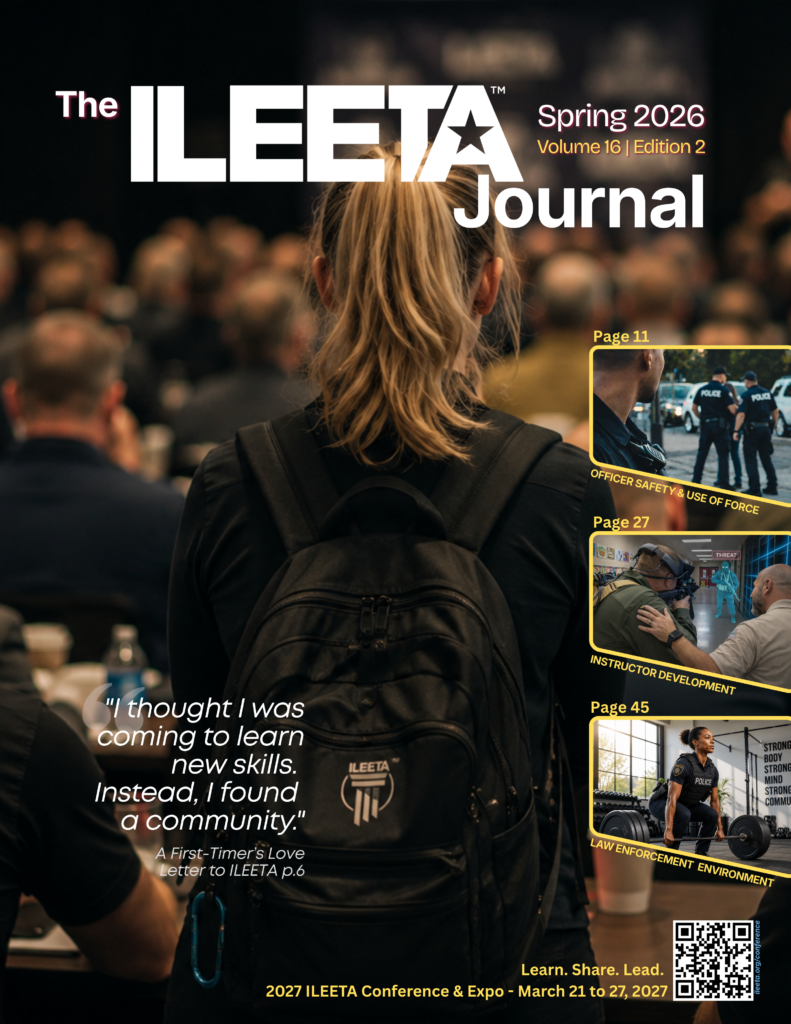
Current public issue
Download the Latest ILEETA Journal
The current issue of The ILEETA Journal is available to the public until the next issue is released. This edition features practical articles, professional insight, and training-focused content for law enforcement educators, trainers, and leaders.
Full access to the ILEETA Journal Archive is an ILEETA member benefit.
Download Current IssueEach year below offers a brief orientation rather than a complete index. Follow the year link to browse the surviving editions, read fuller descriptions, and open complete Journal PDFs.
2026
A record still being written
No verifiable 2026 Journal edition is currently available here. Because the year remains in progress, this is an invitation to help preserve the record—not a conclusion that no issue was published. Members and contributors with an original PDF or distribution details can help complete this year.
Preservation · Current record · Member contributions
Visit the 2026 archive2025
Legacy, evolution, and connection
The surviving Fall edition presents an association consciously linking its history with its future. Its pages introduce the language of Legacy, Evolution, and Connection while exploring professional networks, competency-based training, human factors, leadership, wellness, and lessons drawn from international practice.
Professional community · Competency · Human factors · Leadership
Explore 20252024
Continuity through leadership transition
The available editions follow ILEETA through a planned change in executive leadership without losing sight of the conference, the Journal, or service to trainers. They also record international exchange in Germany and increasingly mature discussions of artificial intelligence, research, adaptive leadership, feedback, and instructional integrity.
Leadership succession · International reach · AI · Research
Explore 20242023
Full conference life and the next generation
Four editions show a training community gathering in strength again while thinking deliberately about succession. Contributors address learning research, scenario stress, firearms instruction, wellness, artificial intelligence, and professional community. Harvey Hedden’s announcement of the planned transition to Ray Merlin gives the year particular institutional importance.
Succession · Scenario training · Learning research · AI
Explore 20232022
Recovery, renewal, and better learning
The Journal returns repeatedly to how people actually learn and perform: retrieval, practice, feedback, stress, culture, leadership, field training, defensive tactics, PTSD, and investigative interviewing. A recurring question runs beneath the year—are trainers evaluating decisions carefully, or merely judging outcomes after the fact?
Learning science · Performance · Culture · Decision-making
Explore 20222021
Rebuilding face-to-face connection
Still living with the effects of 2020, trainers begin reconnecting in person and taking stock of what had been lost, learned, or allowed to decay. Four editions examine the return to St. Louis, problem-based learning, force-skill retention, communication, leadership, mental-health response, and the difficult work of gathering reliable officer-suicide data.
Reconnection · Skill decay · Mental health · Problem-based learning
Explore 20212020
Training through disruption
A complete conference edition was prepared, but the pandemic canceled the gathering and disrupted in-service instruction across the profession. Later editions capture instructors adapting in real time—moving learning online, reconsidering wellness and moral injury, and trying to preserve readiness, standards, and community through an extraordinary interruption.
COVID-19 · Online learning · Moral injury · Adaptation
Explore 20202019
Training craft, community, and remembrance
A large St. Louis conference edition anchors a year of writing on adaptive decisions, field training, sleep, suicide, and human performance. The winter tribute to founder Ed Nowicki brings the association’s personal history into view and shows how strongly its training mission was bound to relationships, generosity, and service.
Ed Nowicki · Field training · Wellness · Human performance
Explore 20192018
A new gathering place in St. Louis
The conference’s move to St. Louis gives the year a visible sense of arrival and renewal. Across four editions, authors press for stronger evidence, meaningful learner participation, better scenarios, honest evaluation, empathy, leadership, wellness, and training habits that support excellent performance rather than merely comfortable repetition.
St. Louis · Evidence · Evaluation · Learner participation
Explore 20182017
The responsibility to keep learning
From conference preparation through winter reflection, the Journal follows force decision-making, field training, scenario design, report writing, mental health, resilience, and instructor growth. The year repeatedly challenges experienced trainers to remain students of their craft even after expertise and reputation have been earned.
Instructor growth · Force decisions · Resilience · Reporting
Explore 20172016
A year-round companion to the training community
Four available editions show the Journal functioning well beyond conference week. The conference issue helps members navigate a broad curriculum, while later writing extends conversations about scenario fidelity, instructional design, supervision, wellness, evidence, public trust, and the hard work of transferring classroom ideas into field performance.
Scenario fidelity · Instructional design · Supervision · Public trust
Explore 20162015
Help fill a gap in the record
No 2015 Journal edition is currently available in the digital collection. The year page explains what would help restore it and invites original PDFs, publication details, and member copies. Institutional memory often survives because someone recognized that a once-routine file would matter later.
Archival recovery · Member copies · Institutional memory
Visit the 2015 archive2014
Visible renewal in format and focus
A redesigned conference edition introduced a more flexible digital presentation, brought officer safety and use of force into closer conversation, and broadened reviews into a resource section. The available issues pair operational subjects with sustained attention to how instructors design, measure, and adapt training.
Digital redesign · Officer safety · Course design · Measurement
Explore 20142013
Ten years of ILEETA and a widening Journal
The surviving Spring and Fall issues document ILEETA’s tenth-anniversary period, editorial succession, evidence-based aspirations, and a growing range of instructor-development material. They show the Journal becoming a broader home for the varied disciplines and professional questions gathered under ILEETA.
Tenth anniversary · Editorial succession · Evidence · Instructor development
Explore 20132012
The broader ILEETA Journal takes shape
Three surviving editions document the first preserved full year after ILEETA’s specialized publications were brought together in a broader Journal. The result is a more expansive forum where force, officer safety, instructor development, leadership, health, and professional resources can share the same pages.
Publication consolidation · Broader scope · Instructor resources
Explore 20122011
The end of one Journal and the beginning of another
The available issues preserve a major publication transition. Volume 11, Number 3 identifies itself as the final issue of The ILEETA Use of Force Journal and announces that it will join other association publications in a broader ILEETA Journal—expanding the editorial frame beyond a single training specialty.
Publication transition · Use of force · Broader association voice
Explore 20112010
Judgment, force, and instructor responsibility
The surviving first-quarter issue preserves practical writing for trainers working at the intersection of tactics, judgment, law, and organizational responsibility. Its value lies not only in individual recommendations but in showing how the profession framed recurring training problems at the opening of a new decade.
Use of force · Judgment · Liability · Instructor responsibility
Explore 20102009
Practical training in a demanding profession
Two surviving issues carry forward the specialized Use of Force Journal’s combination of legal awareness, tactical instruction, equipment discussion, and trainer development. Read together, they preserve the questions instructors were asking about preparation, performance, safety, and defensible decision-making.
Tactical instruction · Legal awareness · Safety · Performance
Explore 20092008
A focused window into use-of-force training
The surviving April–June issue offers a concentrated look at the professional conversation among force instructors. The featured reading connects tactics with articulation, policy, instructor preparation, technology, and the continuing obligation to evaluate whether inherited training practices remain sound.
Force instruction · Articulation · Policy · Training practice
Explore 20082007
“Rekindle the spirit of training”
The earliest surviving issue in this collection examines instructor selection, training liability, force documentation, realistic scenarios, non-lethal-force policy debates, emerging simulator technology, and TASER exposure. It captures trainers working to connect tactics and judgment with legal articulation, professional development, safety, and organizational responsibility.
Instructor selection · Liability · Scenarios · Use-of-force articulation
Explore 2007Back to top