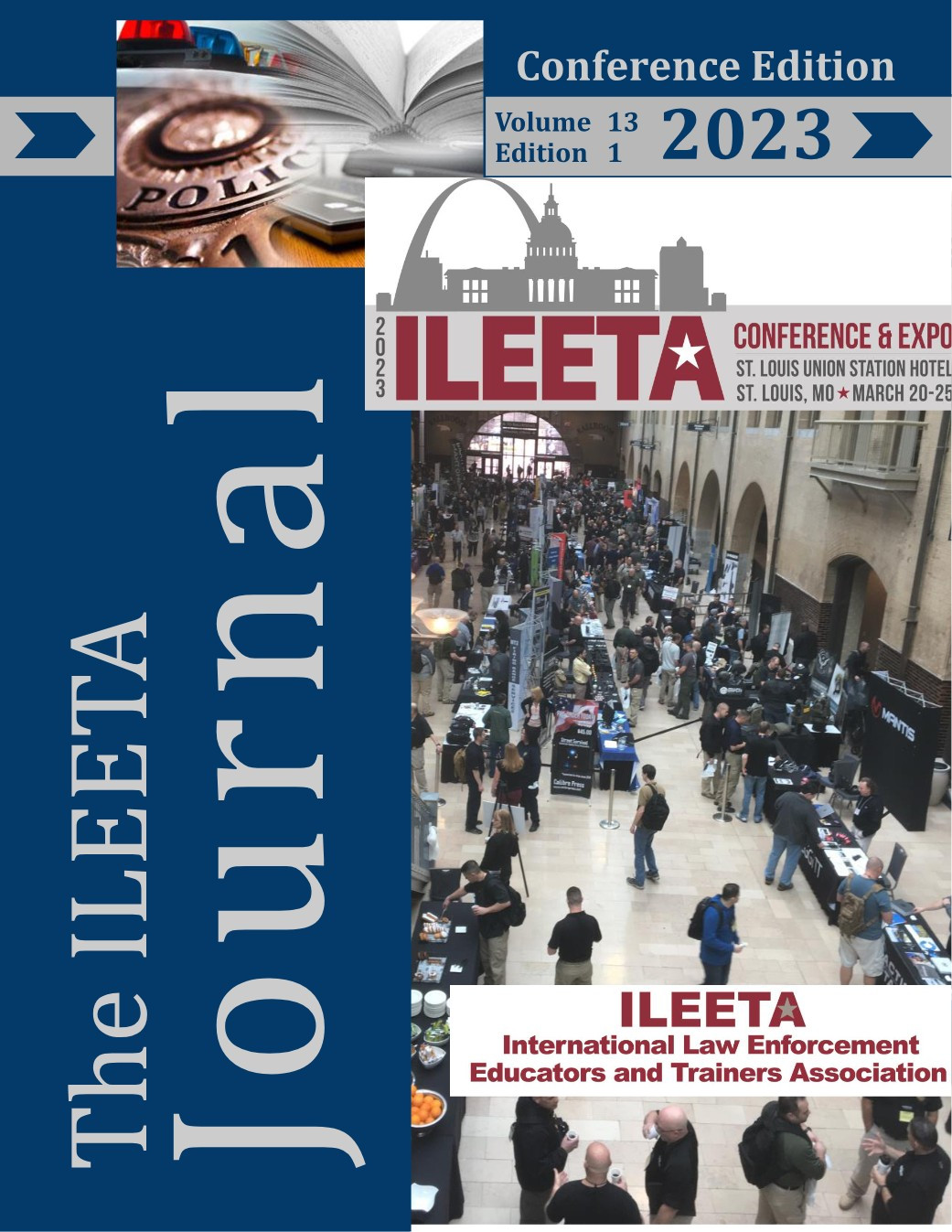
 Volume 13, Edition 1
Conference Edition 2023
Read the complete issue
ILEETA Journal Archive
The 2023 Journal records an association returning to full conference life while thinking deliberately about its next generation. Across four surviving editions, contributors examine learning research, scenario stress, artificial intelligence, firearms instruction, leadership, wellness, and professional community. The fall issue is especially important for preserving Harvey Hedden’s public account of ILEETA’s planned leadership transition.
Volume 13, Edition 1 Volume 13, Edition 2
 Volume 13, Edition 3
 Volume 13, Edition 4
A large conference edition built around preparing for St. Louis, learning actively, strengthening instruction, and examining tactical, legal, wellness, and leadership questions.
Hedden treats the annual conference as an active learning and relationship-building opportunity rather than a passive schedule of classes. He urges attendees to plan around agency needs, study instructors and course descriptions, try unfamiliar subjects, participate in the Emerson Hour and Expo, and make deliberate professional contacts. The piece preserves practical details of the 2023 event—including first-timer orientation, the conference app, repeated two-hour blocks, and expectations for live-fire classes—while also expressing a durable ILEETA ideal: members increase the conference’s value by helping one another and engaging fully.
Topics: Conference preparation; professional networking; adult learning; ILEETA culture
Citation: Harvey Hedden. (2023). Maximizing Your ILEETA Conference. The ILEETA Journal, 13(1), 4-5.
Nelson asks trainers to consider what happens psychologically after a realistic scenario ends. Stress exposure can aid preparation, but repeated simulated trauma without purposeful recovery or emotional processing may create another kind of training scar. She argues that tactical debriefing alone may overlook cumulative strain, especially when officers move through multiple intense scenarios and then immediately return to ordinary duties. The article invites instructors to normalize evidence-informed decompression, examine the mental-health effects of scenario design, and recognize that realism is not automatically beneficial when psychological load is ignored.
Topics: Scenario-based training; stress; mental health; debriefing
Citation: Alexandra Kitty Nelson. (2023). Stop Hurting My Brain! A Panel Discussion of the Psychological Impacts of Scenario-Based Training. The ILEETA Journal, 13(1), 35-36.
A post-conference issue that marks the return of a fully attended conference and engages emerging questions about AI, visual teaching, range culture, burnout, leadership, and officer preparation.
Avery offers an early Journal encounter with generative AI by printing a ChatGPT response to a prompt about improving law-enforcement training, then interrogating the technology rather than simply celebrating it. The generated text proposes personalized learning, simulations, interactive exercises, and real-time feedback. Avery’s framing makes the article historically useful: it captures the moment when trainers were beginning to test a widely available language model and to ask what it could produce, how quickly it worked, and where human judgment still had to remain in control.
Topics: Artificial intelligence; ChatGPT; instructional design; emerging technology
Citation: Kerry Avery, M.Ed.. (2023). Artificial Intelligence Advancing at the Speed of Light. The ILEETA Journal, 13(2), 16-17.
The fall edition combines instruction and leadership articles with a first-person announcement of the succession planned after the 2024 conference.
Hedden announces that Ray Merlin will succeed him after the 2024 ILEETA Conference and identifies Joe Willis, Brian Willis, Jenny Merlin, Mary Grace Barbye, and Marla Hedden within the transition. He also supplies a concise institutional memory: Ed Nowicki formed ILEETA in 2003; Hedden served first as deputy executive director and then as executive director beginning in 2009. The article stresses continuity, succession planning, service to members, and a transition designed to avoid disruption. It is one of the clearest surviving primary-source accounts of ILEETA’s leadership handoff.
Topics: Leadership succession; institutional history; Ray Merlin; Harvey Hedden
Citation: Harvey Hedden. (2023). The Next Generation of ILEETA Leadership. The ILEETA Journal, 13(3), 4-5.
The year-end issue looks toward 2024 while emphasizing evidence-informed instruction, decision-making, motor learning, instructor development, leadership, and wellness.
The authors report on an Academy Innovations Research Project study of integrated instruction in five police academies. Instead of teaching communication concepts once in an isolated block, integration reinforces them consistently across subjects and instructors. The article explains the study design, the problem of rapid and siloed academy delivery, and the importance of retention after graduation. It gives trainers a research-grounded example of curriculum design aimed at transfer rather than short-term recall—and a reminder that coordination among instructors is part of the learning system.
Topics: Academy training; integrated curriculum; retention; research
Citation: Dianne Beer-Maxwell, Jon Blum, Timothy Bonadies, and Peggy Schaefer. (2023). Integration Improves Learning Outcomes in Police Academy Training. The ILEETA Journal, 13(4), 22-24.